AI app builders — tools that let you create software by describing what you want in plain language — went from early experiments to an industry-defining market in under two years. As of early 2026, Microsoft reports 4.7 million paid Copilot subscribers, Cursor has crossed $1B in annualized revenue faster than any B2B company in history, and Gartner forecasts $2.52 trillion in worldwide AI spending this year.
This page collects the most important statistics on AI app builders, code generation, and no-code market trends in 2026 — sourced from earnings calls, developer surveys, research firm reports, and academic studies. Every stat includes its primary source so journalists, researchers, and founders can cite with confidence. Use the “Copy stat” buttons to grab citation-ready text, or “Copy link” to share a direct link to any data point.
Last updated: February 2026. We update this page regularly as new data is published.
Key Takeaways
The headline numbers. Click any card to copy a citation-ready stat.
of developers regularly use AI tools for coding and development
Source: JetBrains Developer Ecosystem, 2025
of new code at Google is now AI-generated
Source: Sundar Pichai, Alphabet Q1 2025 Earnings, 2025
AI App Builder Market Size & Growth in 2026
The AI code tools market is one of the fastest-growing segments in enterprise software. Gartner’s January 2026 forecast puts total worldwide AI spending at $2.52 trillion this year — a 44% increase over 2025.
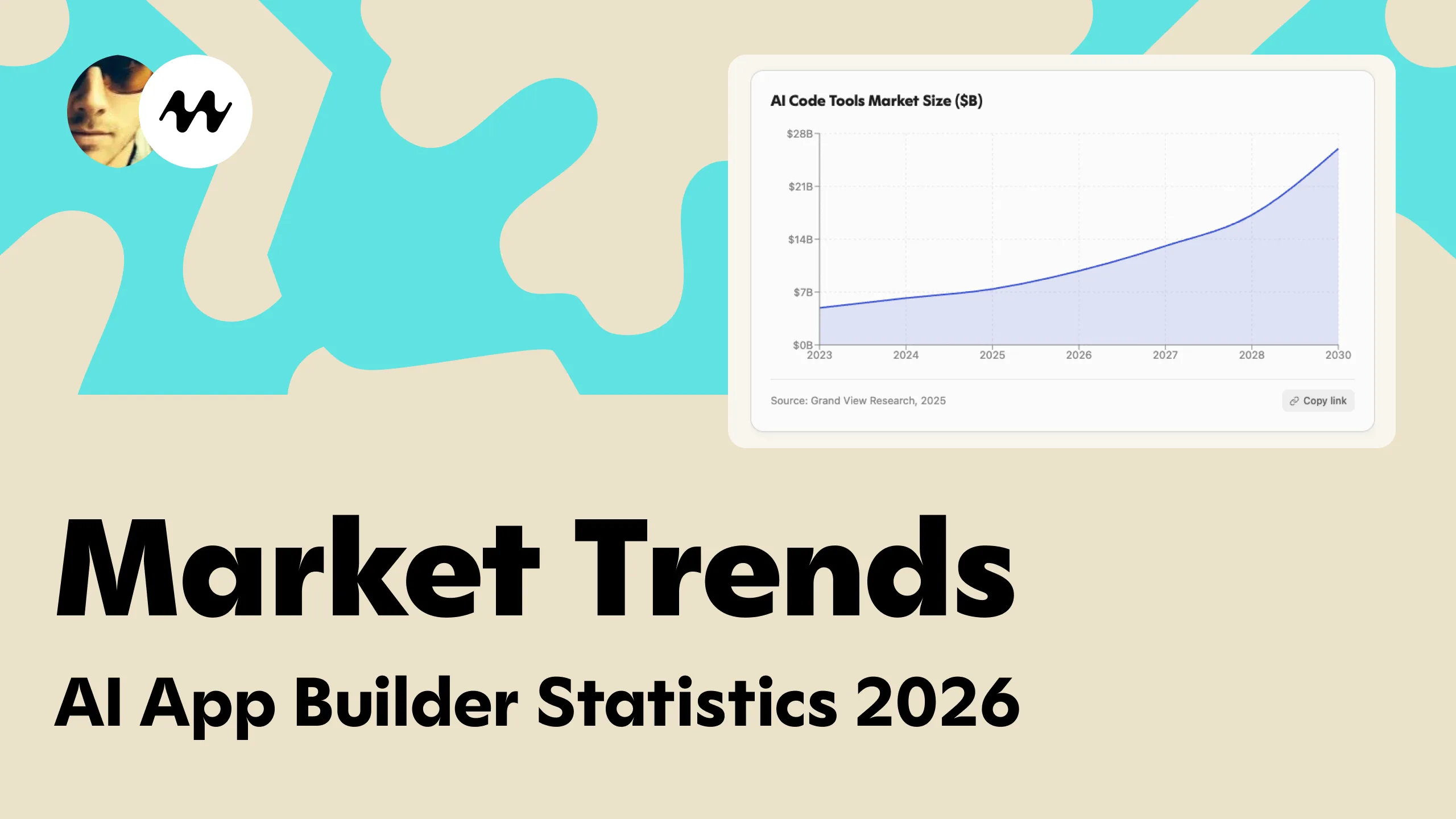
- The global AI code tools market was valued at $4.86 billion in 2023 and is projected to reach $26.03 billion by 2030 at a 27.1% CAGR (Grand View Research)
- AI infrastructure alone will add $401 billion in spending in 2026, with AI-optimized server spending up 49% (Gartner, January 2026)
- Bessemer Venture Partners reports AI is now the highest-valued category in their Cloud 100 at $176 billion — with AI companies reaching the $100M revenue milestone in 5.7 years vs. the 7.5-year average (Bessemer State of AI, 2025)
The revenue trajectories of individual platforms tell the story just as clearly:
- Cursor went from $0 to $1B+ annualized revenue in roughly 24 months — the fastest-scaling B2B company on record (Sacra)
- Lovable hit $206M ARR in November 2025, up from $7M at end of 2024 — a 2,800% YoY growth rate (Sacra)
- Replit reached an estimated $253M ARR by October 2025, up 15.8x from $16M at end of 2024 (Sacra)
AI Code Tools Market Size ($B)
The growth isn’t just from developers adopting new tools — it’s from entirely new categories of users who never wrote code before. Platforms like Mocha, Replit, Lovable, and Bolt are bringing app creation to entrepreneurs, marketers, and small business owners.
AI Code Generation Adoption Rates
AI coding tools have crossed the adoption threshold faster than almost any previous developer technology. But the story in early 2026 is more nuanced than just “everyone uses them” — trust is becoming the next battleground.
positive sentiment for AI tools, down from 70%+ in prior years
Source: Stack Overflow Developer Survey 2025, 2025
The data across three major developer surveys paints a consistent picture:
- 85% of developers regularly use AI for coding; 62% rely on at least one AI coding assistant, agent, or code editor (JetBrains, 24,534 respondents across 194 countries)
- 84% of developers are using or planning to use AI tools, up from 76% the prior year (Stack Overflow Developer Survey 2025, 49,000+ respondents)
- 180+ million developers now build on GitHub, with 36 million new developers joining in one year — more than 1 per second (GitHub Octoverse 2025)
- GitHub Copilot has 4.7 million paid subscribers as of January 2026, growing 75% year-over-year (Microsoft FY26 Q2 Earnings)
But developer trust is actually declining:
- Positive sentiment for AI tools dropped to 60% in the Stack Overflow 2025 survey, down from 70%+ in 2023-2024
- 66% of developers cite “AI solutions that are almost right, but not quite” as their biggest frustration
- 46% actively distrust AI tool accuracy, compared to only 33% who trust it
AI Coding Tool Adoption by Company Size (%)
How Much Code Is AI-Generated?
The proportion of AI-generated code keeps climbing — and the numbers are now coming from major tech companies’ earnings calls, not just surveys.
- 30%+ of all new code at Google is AI-generated, up from 25% six months prior (Sundar Pichai, Alphabet Q1 2025 earnings call, April 2025)
- AI-generated code output grew from 20% to 29% of total output year-over-year in the JavaScript ecosystem (State of JS 2025)
- 41% of all code written globally is AI-generated, across 256 billion lines analyzed (JetBrains Developer Ecosystem 2025)
- GitHub Copilot generates an average of 46% of code for its users; Java developers reach 61% (GitHub, 2025)
- Among Y Combinator’s Winter 2025 batch, 25% of companies have codebases that are 95% or more AI-generated (Garry Tan, YC CEO)
The productivity paradox
A landmark randomized controlled trial from METR (July 2025) found that AI tools actually made experienced open-source developers 19% slower — even though those developers believed they were 20% faster. Developers predicted a 24% speedup before tasks; the actual result was a 19% increase in completion time. (METR study, arXiv)
Anthropic’s own research tells a different story at the task level: Claude speeds up individual tasks by approximately 80% for tasks averaging ~90 minutes, and could increase US labor productivity growth by 1.8% annually over the next decade (Anthropic Economic Index, January 2026).
The discrepancy likely comes down to task complexity and tool maturity. The truth is somewhere in between — and rapidly shifting.
AI Software Development in the Enterprise
Enterprises and startups are adopting AI coding tools at different paces and for different reasons.
Key enterprise stats from primary sources:
- 75% of enterprise software engineers will use AI code assistants by 2028, up from under 10% in early 2023 (Gartner)
- 40% of enterprise apps will feature task-specific AI agents by end of 2026, up from under 5% in 2025 (Gartner, August 2025)
- 90% of Fortune 100 companies use GitHub Copilot (GitHub Octoverse 2025)
- Companies with 80-100% developer AI adoption see productivity gains of more than 110% (McKinsey)
- 91% of C-suite executives say software innovation is a core business priority; 89% expect agentic AI to become the industry standard within 3 years (GitLab C-Suite Survey, 2,786 executives)
The GitLab 2025 DevSecOps Report (3,266 respondents) adds important nuance:
- Teams lose nearly a full workday (7 hours) per team member per week to AI-related inefficiencies
- 49% of developers use more than 5 AI tools — tool sprawl is becoming a real problem
- 76% believe AI will create more engineers, not fewer (GitLab)
Startups are moving faster:
- Y Combinator’s W25 batch grew 10% per week in aggregate — the fastest-growing and most profitable in fund history
- Companies reaching $10M revenue with teams of fewer than 10 people is becoming common in the YC ecosystem
- DORA (Google Cloud) renamed its flagship report from “Accelerate State of DevOps” to “State of AI-Assisted Software Development” in 2025 — a signal of how central AI has become to engineering (DORA 2025)
AI Impact on Developer Jobs & Hiring
The labor market data from early 2026 shows a clear pattern: AI-specific roles are surging while broader hiring remains weak.
overall hiring vs. pre-pandemic (May 2019), in a 'low-hire, low-fire' environment
Source: Indeed Hiring Lab, 2026
- Overall hiring is down 17% compared to pre-pandemic levels, but jobs mentioning AI are growing amid broader weakness (Indeed Hiring Lab, January 2026)
- 81% of skills in the typical software development job posting fall into “hybrid transformation” classifications — meaning AI changes the job, but doesn’t eliminate it (Indeed Hiring Lab AI at Work Report)
- The Bureau of Labor Statistics still projects 15% growth in software developer employment from 2024-2034, with 129,200 openings per year — much faster than average (BLS)
- C-suite executives report average savings of $28,249 per developer annually from AI investments, translating to $750+ billion in potential global value across the world’s 27 million developers (GitLab)
- Anthropic estimates current-generation AI could increase US labor productivity growth by 1.8% annually over the next decade — roughly double the recent run rate (Anthropic Economic Index)
The role of “developer” is evolving. As Indeed’s research puts it: developers are shifting from “doing the work” to “directing the work.”
AI Coding Tools & No-Code Platforms
The AI app builder and coding tools landscape is evolving fast. A few revenue milestones stand out:
- Cursor went from $0 to $1B+ annualized revenue in ~24 months, with 1M+ daily active users and a $29.3B valuation — the fastest-scaling B2B company on record (Sacra)
- Replit has 35M+ users across 200+ countries, with an estimated $253M ARR and 750,000+ businesses on the platform (Sacra)
- Lovable reached ~8 million users and $206M ARR in November 2025, up from $7M at end of 2024 — with 100,000 new products built on the platform per day (Sacra)
- GitHub Copilot has 4.7 million paid subscribers, growing 75% YoY, with 90% of Fortune 100 companies using it (Microsoft FY26 Q2 Earnings)
- Bolt (by StackBlitz) hit $40M ARR in 5 months with 5M+ users, adding over 1M new users per month (Sacra)
Most of these platforms focus on developers or on generating standalone frontends. Mocha takes a different approach: a complete platform where auth, database, backend, payments, and hosting are all built in — no external services, no gluing tools together. It’s built for non-technical entrepreneurs who want real, working apps — not just prototypes
AI App Development Market Trends 2026 & Beyond
The data points toward a fundamental restructuring of who builds software and how.
Key projections for 2026 and beyond:
- $2.52 trillion in worldwide AI spending in 2026, with AI currently in the “Trough of Disillusionment” according to Gartner — meaning it’s being sold by incumbent vendors, not bought as moonshot projects (Gartner, January 2026)
- The AI code tools market is projected to hit $26 billion by 2030, up from $4.86B in 2023 (Grand View Research)
- 89% of C-suite executives expect agentic AI to become the industry standard within 3 years (GitLab)
- 52% of AI users now work with AI as a thinking partner (augmentation) rather than pure delegation; directive automation jumped from 27% to 39% of conversations in nine months (Anthropic Economic Index)
- A16z’s analysis of 100+ trillion tokens flowing through OpenRouter shows creative and coding use cases remain the largest drivers of AI token volume (a16z State of AI)
The common thread? The barrier between “having an idea” and “building that idea” is disappearing. Tools like Mocha exist specifically for this moment — letting non-technical people build complete, functional web applications by just describing what they want.
If you’re curious about the practice itself, read our guides on what vibe coding is and the best vibe coding tools.
Methodology & Sources
This article compiles statistics from earnings calls, developer surveys, research firm reports, and academic studies. We prioritize primary sources over media coverage. Sources include:
2026 Primary Sources
- Microsoft FY26 Q2 Earnings Call (January 28, 2026) — GitHub Copilot subscriber data
- Gartner Worldwide AI Spending Forecast (January 15, 2026) — AI market sizing
- Indeed Hiring Lab January 2026 Update — Labor market trends
- Anthropic Economic Index, January 2026 Report — AI productivity impact
Developer Surveys (Late 2025)
- Stack Overflow Developer Survey 2025 (December 2025, 49,000+ respondents) — Adoption and trust data
- JetBrains State of Developer Ecosystem 2025 (October 2025, 24,534 respondents) — AI usage patterns
- GitHub Octoverse 2025 (October 2025) — Platform growth and developer trends
- State of JS 2025 (December 2025) — JavaScript ecosystem AI adoption
Industry Reports
- GitLab 2025 DevSecOps Report (November 2025, 3,266 respondents) — Enterprise AI adoption
- GitLab C-Suite Survey (July 2025, 2,786 executives) — Executive investment priorities
- DORA State of AI-Assisted Software Development 2025 (September 2025) — DevOps AI impact
- McKinsey: Unlocking AI Value in Software Development — Productivity gains
- Bessemer State of AI 2025 — VC market analysis
- a16z State of AI — Token usage and market trends
Academic & Research Studies
- METR: AI Impact on Experienced Developer Productivity (July 2025) — Randomized controlled trial
- Anthropic: AI’s Impact on Software Development — Task-level productivity analysis
- Indeed Hiring Lab AI at Work Report 2025 — Labor market transformation
Market Research & Company Data
- Grand View Research: AI Code Tools Market — Market sizing
- Sacra — Company-level revenue and growth analysis (Cursor, Replit, Lovable, Bolt)
- Gartner AI Code Assistants Forecast — Enterprise projections
- Bureau of Labor Statistics — Developer employment outlook
A note on data quality: AI coding statistics are a fast-moving target. Some figures (like market size projections) vary significantly between research firms. We prioritize primary sources — earnings calls, survey data with disclosed methodology, and peer-reviewed research — and note the source for every stat so you can evaluate credibility yourself.
Updates: We aim to update this page regularly. If you spot an outdated stat or have a more recent source, reach out to us.