
TL;DR: v0 is best-in-class for generating React UI components inside the Vercel ecosystem — but it’s built for developers, not the other 99% of people with ideas. Emergent goes further with full-stack generation, but a 2.7/5 Trustpilot rating and an aggressive credit system give many users pause. Mocha is built for everyone else: auth, database, payments, and hosting are all included, so you go from prompt to production without configuring anything — no coding required.
Why People Look for v0 Alternatives
Credit where it’s due: v0 pioneered AI-powered UI generation. The ability to describe a component and get clean, well-typed React code with shadcn/ui styling was genuinely ahead of its time. For developers already in the Vercel ecosystem, it remains a strong choice.
But three pain points keep pushing users to look elsewhere.
Framework lock-in. v0 outputs Next.js and only Next.js. If your team uses Vue, Svelte, or anything else, v0 isn’t an option. And while you can export the code and deploy it outside Vercel, the tightest integration — and the path of least resistance — keeps you inside the Vercel ecosystem.
Credit burn. In May 2025, v0 shifted from nearly unlimited usage to token-based credit pricing. The community reaction was swift. Users on the Vercel Community forums report burning through $20 in Premium credits in 3-5 days of active development. One developer spent $18 in a single 2-hour session. Worse, you’re billed for AI mistakes too — every failed generation costs credits.
The backend blind spot. v0 has added database integrations (Supabase, Neon, Upstash), but you still can’t preview backend logic in the editor. For anything beyond a UI prototype, you need Next.js knowledge to wire up data, debug API routes, and handle state management. The gap between “beautiful mockup” and “working app” remains wide.
If you’ve hit these walls, you’re not alone. For a broader look at the landscape, see our full AI app builder comparison. This article zooms in on v0 specifically and the two alternatives most worth considering: Emergent and Mocha.
v0 vs Emergent vs Mocha at a Glance
Before diving into each tool, here’s how they compare on the features that matter most.
| Feature | v0 | Emergent | Mocha |
|---|---|---|---|
| Free tier | Yes (limited) | Yes (limited) | Yes (1 app) |
| Entry paid | $20/mo | $20/mo | $20/mo (5 apps) |
| Mid tier | $30/user/mo | — | $50/mo (15 apps) |
| Top tier | $100/user/mo | $200/mo | $200/mo (25 apps) |
| Database | You provision (Supabase/Neon/Upstash) | Built-in | Built-in (zero-config) |
| Auth | External setup required | Built-in | Built-in (Google OAuth works instantly) |
| Payments | External setup required | Stripe ($200/mo plan only) | Built-in Stripe (all paid plans) |
| Hosting | Vercel (custom domains supported) | Built-in (custom domains supported) | Built-in (custom domains on paid plans) |
| Backend preview | No | Yes | Yes |
| Target user | Developers (Next.js) | Developers + technical founders | Everyone else (the other 99%) |
| Ecosystem lock-in | Vercel | None | None |
| Trustpilot rating | Mixed | 2.7/5 (Poor) | Positive |
v0 in 2026: What It Does Well and Where It Falls Short
What v0 Gets Right
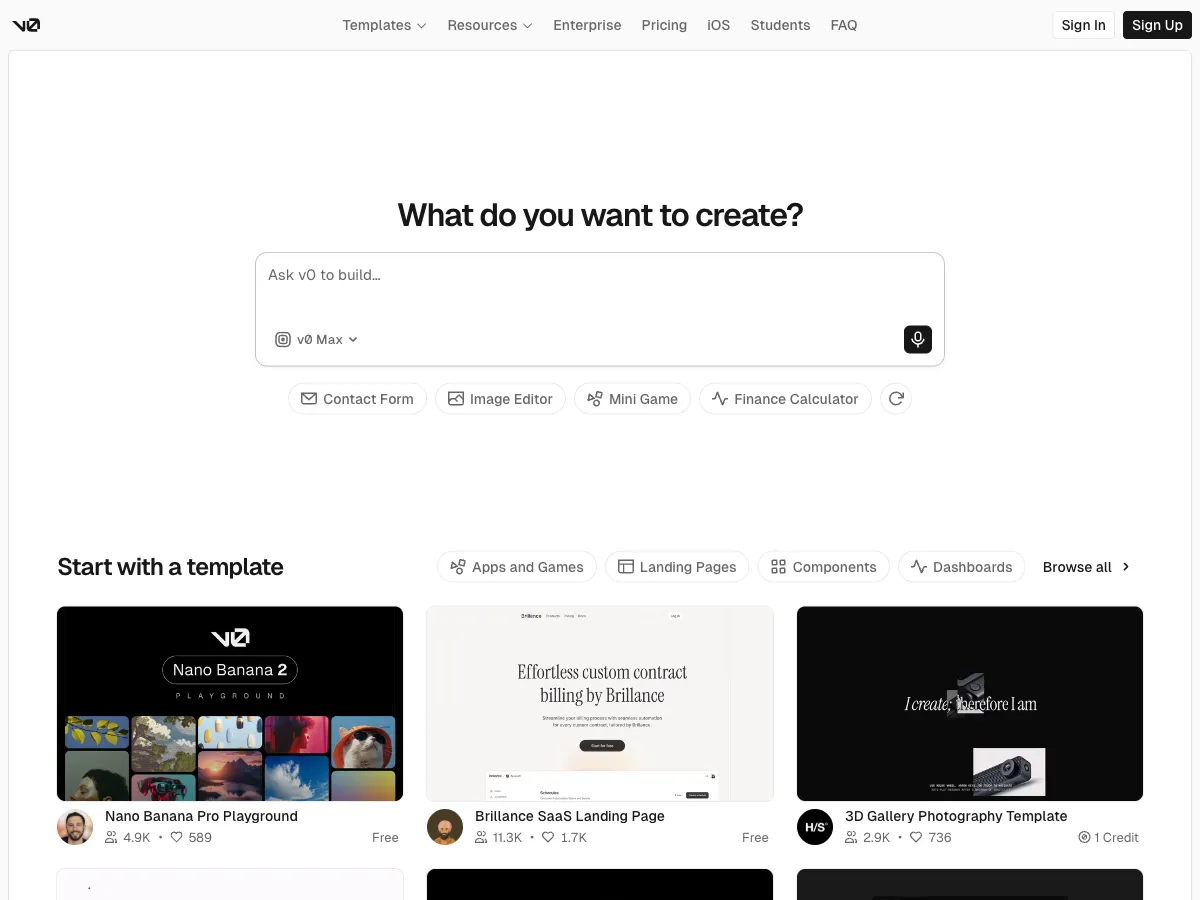
v0’s strengths are real and specific. The UI generation quality is best-in-class — you get clean TypeScript, well-structured shadcn/ui components, and polished designs that actually look like a human designed them. For rapid UI prototyping, nothing else comes close.
One-click Vercel deployment is genuinely seamless. Hit deploy, get a live URL. The code is also exportable — you can push it to GitHub and deploy elsewhere, though Vercel is the path of least resistance.
v0 has also expanded its infrastructure story. You can now provision databases through Supabase, Neon, Upstash, or Vercel Blob directly from the editor. Stripe sandbox integration is available with one click. And Figma import lets you turn existing designs into code.
For teams already invested in the Vercel/Next.js ecosystem, v0 is the natural choice. It plays to Vercel’s strengths and integrates tightly with the rest of their platform.
Where v0 Struggles
Credit burn is real. Users consistently report that the $20/mo Premium plan doesn’t last. On the Vercel Community forums, developers describe burning through credits in 3-5 days. One user built a 7-section landing page and used 12 of 20 credits on day one.
You’re billed for AI mistakes. As one user wrote on Medium: “Vercel v0 can make mistakes — and I get billed for every single one.” When the AI generates broken code, you pay for the attempt and for the follow-up prompts to fix it.
Backend opacity. You can’t preview backend logic in the editor. For simple frontends this is fine, but the moment your app needs real data flows, authentication logic, or API integrations, you’re working blind until you deploy. As one analysis noted, “You won’t be able to preview an app if it has backend logic.”
Iteration hell. Fixing one issue often introduces another. Developers report needing 20+ iterations to get complex components working — each one burning credits. v0 has also been reported to re-lock files users just unlocked and modify files that weren’t part of the current prompt.
Framework lock-in. React/Next.js only. No Vue, Svelte, or Angular support.
Reliability concerns. Users on the Vercel Community have reported conversations being deleted, projects disappearing, and generation stopping midway through. One thread is titled “Is v0 still a reliable AI solution for developers?” — not the question you want users asking.
v0 Pricing Breakdown
| Plan | Price | What You Get |
|---|---|---|
| Free | $0 | 7 messages/day, $5 monthly credits |
| Premium | $20/mo | $20 monthly credits + $2 daily complimentary |
| Team | $30/user/mo | Shared workspace, higher limits |
| Business | $100/user/mo | Priority support, advanced features |
| Enterprise | Custom | Custom terms |
Emergent: Full-Stack AI with Growing Pains
What Emergent Gets Right
Emergent goes where v0 doesn’t — it generates complete applications, not just UI components. Database, auth, and backend are included from day one. You describe a full-stack app in a prompt, and Emergent builds the whole thing.
The platform has scale: 5M+ users have built 6M+ apps on Emergent. That’s not a startup experiment — it’s a real platform with real traction. Reddit sentiment often points to Emergent as the tool to use “if you’re building something to charge money for.”
For developers who want AI assistance building complex applications, Emergent’s capabilities genuinely exceed v0’s scope.
Where Emergent Struggles
A 2.7/5 Trustpilot rating is hard to ignore. With ~198 reviews rated “Poor,” the breakdown is striking: 50% are 1-star, 38% are 5-star, and almost nothing in between. Users either love Emergent or have a terrible experience — there’s little middle ground. For a platform handling your application data, that polarization is a red flag.
The credit trap. Emergent’s credit system is its most consistent criticism. One user wrote on Medium: “Emergent is a powerful AI app builder but its credit system is a trap.” Another exhausted 550 credits on a single app. Users on Trustpilot report spending $400-500 per project because the AI gets stuck in debugging loops — fixing its own mistakes while charging credits for every attempt.
Data persistence concerns. Individual users have reported apps being lost or reverted after incidents. Emergent recommends saving projects to GitHub as a recovery method. No confirmed platform-wide outage has been independently verified, but the number of individual reports on Trustpilot is concerning for anyone building mission-critical apps.
The pricing cliff. Emergent jumps from $20/mo to $200/mo with no mid-tier. Want Stripe integration? That’s the $200/mo Pro plan. There’s a 10x price jump between “hobbyist” and “serious builder.”
Support quality. Multiple Trustpilot reviews describe support responses as “evasive and repetitive” — generic copy-paste replies that don’t address specific issues.
Deployment mismatch. Users report that deployed apps don’t match the preview, with hidden deployment costs that only appear when you click Deploy. Generated code has also been flagged for CORS misconfigurations where the frontend can’t connect to the backend.
Emergent Pricing Breakdown
| Plan | Price | What You Get |
|---|---|---|
| Free | $0 | 10 credits |
| Standard | $20/mo | 100 credits |
| Pro | $200/mo | 750 credits, Stripe access, 1M token context |
Mocha: Zero-Config Full Stack for Everyone

What Mocha Gets Right
Both v0 and Emergent are built for people who already speak “tech.” Mocha is built for the other 99% — the founders, small business owners, coaches, and creators who have ideas worth building but no interest in learning Next.js or debugging CORS errors.
Instead of generating code and asking you to configure infrastructure, everything is built in — auth, database, payments, hosting, email, analytics, and image generation. There’s nothing to connect, nothing to provision, nothing to misconfigure.
This isn’t just a convenience feature. It eliminates entire categories of failure. As NoCode MBA noted: “Development and deployment took minutes, not hours.” Google OAuth works instantly — no Supabase auth configuration, no environment variables, no debugging “permission denied” errors at 2 AM. You can customize with your own credentials if you want, but the default just works.
Under the hood, Mocha automatically splits development and production databases following engineering best practices. You never see this happen — you just never lose production data because you were testing in the wrong environment.
Pricing is predictable: four tiers (Free / $20 / $50 / $200). The $50 mid-tier fills the gap that Emergent’s pricing completely skips. And Stripe payments are available on all paid plans, not locked behind the highest tier.
The MAX Agent uses a more powerful model for complex tasks. Mocha earned Product of the Week on Product Hunt with 751 upvotes, and the platform saw a 175% increase in user iterations after launching its credit system.
Here’s what building an app in Mocha actually looks like — no technical knowledge required:
For a deeper look at how this works technically, see the engineering behind Mocha.
Where Mocha Has Limitations
React/TypeScript only output. Like v0, Mocha doesn’t support Vue, Svelte, or other frameworks. If you need framework flexibility, tools like Bolt.new offer more options.
Opinionated infrastructure. You can’t bring your own database or deploy to your own servers while using the platform. For enterprise teams with strict compliance requirements, this may be a dealbreaker.
Smaller community. v0 benefits from the entire Vercel ecosystem — a massive developer community, extensive documentation, and deep Next.js integration. Mocha’s community is growing but not yet at that scale.
Complex enterprise logic. For extremely intricate business workflows with dozens of conditional branches, a tool like Bubble may still offer more granular control.
Mocha Pricing Breakdown
| Plan | Price | What You Get |
|---|---|---|
| Free | $0 | 120 credits, 1 app |
| Bronze | $20/mo | 1,500 credits, 5 apps |
| Silver | $50/mo | 4,500 credits, 15 apps |
| Gold | $200/mo | 20,000 credits, 25 apps |
Head-to-Head: Pricing Comparison
At the $20/mo entry tier, all three tools look equal. The total cost diverges fast — especially once you factor in what’s included versus what costs extra.
One important distinction: v0 uses per-user pricing on its Team and Business plans, while Emergent and Mocha charge a flat rate regardless of team size. For a 5-person team, v0’s Team plan costs $150/mo, not $30.
Here’s every plan side by side.
| v0 | Emergent | Mocha | |
|---|---|---|---|
| Free | 7 msgs/day | Limited usage | 1 app |
| $20/mo | Premium (limited credits) | Standard | Bronze (5 apps) |
| $30/mo | Team ($30/user/mo) | — | — |
| $50/mo | — | — | Silver (15 apps) |
| $100/mo | Business ($100/user/mo) | — | — |
| $200/mo | — | Pro (+ Stripe, 1M context) | Gold (25 apps) |
| Pricing model | Per-user (Team+) | Flat | Flat |
| Database | External (you provision) | Included | Included (zero-config) |
| Auth | External (you configure) | Included | Included |
| Stripe payments | External (you integrate) | $200/mo plan only | All paid plans |
| Hosting | Vercel | Included | Included |
| Year 1 (solo) | $500-800+ | $240-2,400+ | $240-600 |
What the table reveals:
- v0 looks affordable at $20/mo, but you still need to provision your own database, auth, and payments externally. Supabase Pro alone adds $25/mo. Credit overages are common — users report burning through the $20 allocation in 3-5 days. And once your team grows, per-user pricing compounds fast.
- Emergent jumps from $20/mo to $200/mo with nothing in between. The $20 Standard plan is enough to experiment, not to build a real app. Want Stripe integration? That’s the $200/mo Pro plan.
- Mocha includes everything at every paid tier — database, auth, payments, hosting. The $50/mo mid-tier fills the gap that neither v0 nor Emergent offers. No external services, no per-user scaling, no surprises.
What Real Users Say
v0 User Sentiment
The Vercel Community forums tell a clear story. Users love v0 for quick UI prototyping, but frustration grows when projects get serious.
- “Vercel v0 can make mistakes — and I get billed for every single one” — Medium
- “v0 isn’t worth the money anymore” — Vercel Community
- “Why pay when Cursor Unlimited exists?” — Vercel Community
The consensus: great for mockups, frustrating for production. Developers with access to Cursor or Claude Code increasingly question v0’s value proposition.
Emergent User Sentiment
Emergent’s Trustpilot page is the most polarized in the AI builder space. With ~198 reviews and a “Poor” 2.7/5 rating, the 50/38 split between 1-star and 5-star reviews suggests a tool that either works brilliantly or fails badly.
- “Emergent is a powerful AI app builder but its credit system is a trap” — Medium
- Users report apps reverted or lost after incidents — Trustpilot
- Debugging loops that consume credits without making progress — EESEL AI
Mocha User Sentiment
Mocha’s reception has been consistently positive, particularly from non-technical users who’ve tried other tools first.
- “If you want to generate an app that just works, Mocha is probably the best AI product on the market right now” — Product Hunt
- “Development and deployment took minutes, not hours” — NoCode MBA
- 175% increase in user iterations after the credit system launched — suggesting users are building more, not less
- Product of the Week on Product Hunt (751 upvotes)
Which v0 Alternative Should You Choose?
Choose v0 if: You’re a Next.js developer already on Vercel, you primarily need UI prototyping, and your team handles backend infrastructure. v0 is the best tool for its niche — just understand the niche is narrower than the marketing suggests.
Choose Emergent if: You’re a developer who wants full-stack AI assistance and can tolerate reliability tradeoffs. Emergent can build genuinely complex applications, but go in with eyes open about credit consumption and the 2.7/5 Trustpilot rating. Save to GitHub frequently.
Choose Mocha if: You’re part of the 99% of people who can’t code but have something worth building. Auth, database, payments, hosting — all included, all zero-config. Whether you’re a founder launching a SaaS, a small business owner building a booking system without coding, or someone who’s tried vibe coding and hit the deployment wall, Mocha is built for everyone else.
Frequently Asked Questions
The Bottom Line
v0 remains excellent at what it was designed for — React UI generation within the Vercel ecosystem. If you’re a Next.js developer who needs beautiful components fast, it’s still the best tool for that specific job.
Emergent brings full-stack ambition that v0 lacks, but it needs to solve its reliability and trust issues. A 2.7/5 Trustpilot rating, unpredictable credit consumption, and data persistence concerns make it a tool you use with caution — and with frequent GitHub saves.
Mocha takes a fundamentally different approach. Instead of generating code and hoping you can deploy it, Mocha builds complete, working applications. Auth, database, payments, hosting — all included, all automatic. No Technical Cliff. No configuration screens. No 2 AM debugging sessions because your Supabase RLS policy is wrong.
v0 and Emergent serve the 1% who already know how to code. Mocha is for the other 99% — the people with ideas, businesses, and customers, who just need the thing to work.
Ready to build something real?